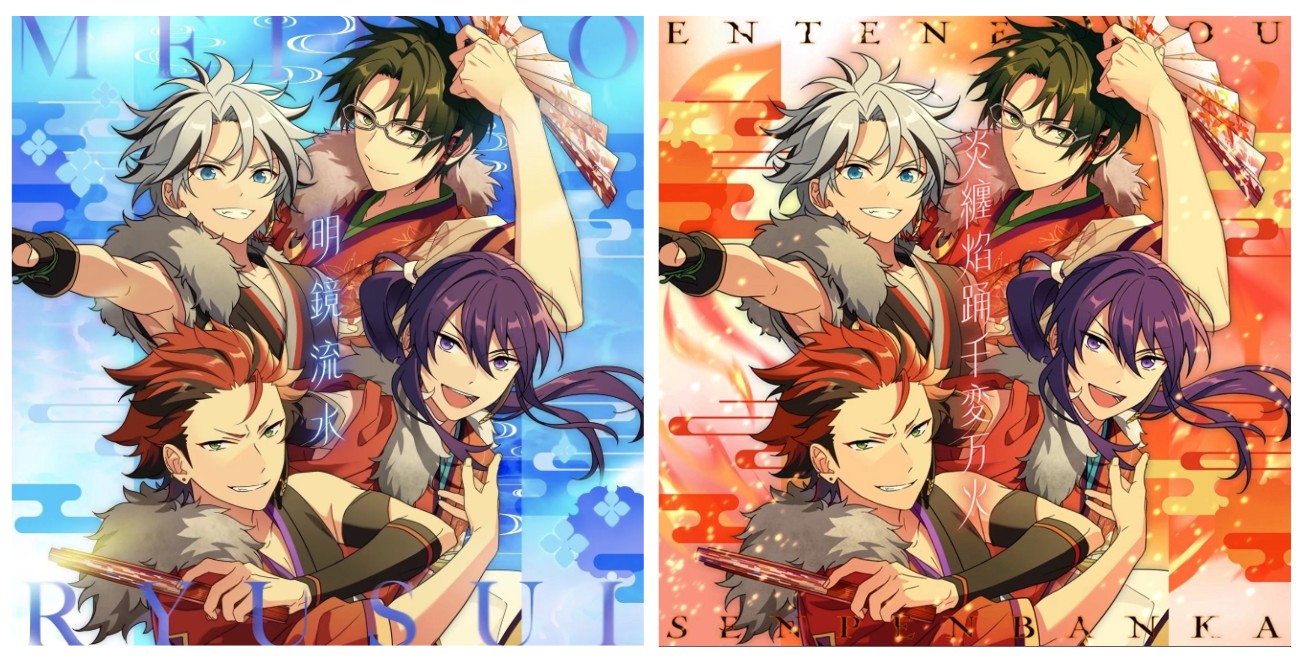
Meikyou Ryusui | Enten Enyou Senpenbanka
Ibuki's entrance into AKATSUKI has insensitive parallels to the history between Japan and the Ryukyu Islands, specifically the annexation of Ryukyu into Okinawa from 1872-1879 onward. Click for more information
AKATSUKI is a unit embodied by 和 (wa, lit. harmony, but also a self-designator for Japan). The word 和風 (wafu, Japanese style) comes from 和. During the Meiji Restoration, 和 was central to Japan’s efforts to unify and assimilate new territories under a shared cultural identity. On top of his membership, Ibuki's active pursuit of 本当の和風 (true Japanese-style) being the reason he pursues AKATSUKI is inappropriate, bearing this in mind.
Additionally, the Ryukyu Disposition was driven by military interests, particularly securing Japan's southern borders from other nations. In Okinawan schools, national pride was linked to serving Japan’s military goals. This had devastating consequences, particularly during the Battle of Okinawa in World War II. This in mind, having Ibuki join the self-proclaimed "war unit" is also inappropriate.
Read the full-length analysis here: Unpacking Shinsei (新生) AKATSUKI; An Extended Translation Note and Analysis.
Unproofread Translations ToS
These song translations are not JP proofread. Unproofread translations are under much stricter terms of service. While these translations are as accurate as I can personally make them, I am not comfortable with and do not permit use of the following:
⦿ Do not take or publicly circulate screenshots of this translation.
⦿ Do not use this translation in analysis threads, story threads, fanworks, quotebots, etc.
I would love to get this story properly proofread and posted one day! If you are a translator interested in JP proofreading this story, feel free to DM me at @citrinesea on X.
Song Production Notes (November 15, 2025)
Two new songs have been made for the AKATSUKI Fan Thanksgiving and Starphony Concert. These two songs express the musical range of the reborn AKATSUKI.
"Meikyou Ryusui," released the other day, is a song tranquilly sung, that uses an abundance of traditional Japanese instrumentation in line with AKATSUKI’s traditional Japanese style. While "Enten Enyou Senpenbanka" definitively uses Japanese scales, it was created without the use of any traditional Japanese instruments. It is also the first song where AKATSUKI has tried to attempt “precise" harmonies.
Meikyou Ryusui
Please check Translation Notes for more details and Interpretation Notes for translation choices in the song.
| Voice | Line | Time |
|---|---|---|
| Verse | ||
| Keito, Kuro | Moonlight slides down the mountainside, as the water’s edge floats, pale blue. | 00:20 |
| Souma, Ibuki | The words we trade here and there dance through the windless thicket. | 00:30 |
| Keito | Before the season deepens | 00:39 |
| Ibuki | This tender air1 | 00:39 |
| Souma | This short respite | 00:39 |
| Kuro | Like a bookmark for tomorrow | 00:39 |
| All | — Shall we tuck them into each other's hearts? | 00:39 |
| Chorus | ||
| All | The water’s mirror, plain and true with its flows and sways, has brought me this far. | 00:39 |
| All | Reflect me, O Water’s Mirror– the pattern of my heart, illuminated by the moonlight. | 00:39 |
| Verse | ||
| Ibuki | Is the water sweet over on your side? | 00:39 |
| Souma | The water's the same on both sides, you know | 00:39 |
| Kuro | It's all in the heart, isn't it? | 00:39 |
| Keito | This futile, silly banter... | 00:39 |
| All | Sweeps merrily into the night breeze | 00:39 |
| Kuro | With the shifting seasons at our backs... | 00:39 |
| Souma | A touch of melancholy | 00:39 |
| Ibuki | And the expectations we have | 00:39 |
| Keito | Neither clear nor murky... | 00:39 |
| All | I accept them as they are | 00:39 |
| Chorus | ||
| All | Even with ripples, it's a mirror. It knows no way of stopping, just like us. | 00:39 |
| All | Show me, O Water’s Mirror– our fighting spirit, illuminated by the moonlight. | 00:39 |
| Verse | ||
| Keito | The water's flow is unceasing. | 00:39 |
| Ibuki | Ebbing, flowing, drifting... | 00:39 |
| Kuro | It surely carries our days along. | 00:39 |
| Souma | Into the clear dawn2 | 00:39 |
| All | Carrying impatient thoughts and dreams, ahhh...3 | 00:39 |
| Chorus | ||
| All | The water’s mirror, plain and true with its flows and sways, has brought me this far. | 00:39 |
| All | Reflect me, O Water’s Mirror– the pattern of my heart, illuminated by the moonlight. | 00:39 |
Enten Enyou Senpenbanka
When I initially translated BUTTERFLY, I was confused as to why Ibuki mentions Kuro when speaking about the AKATSUKI songs he's composing with Keito and Souma. When Enten Enyou Senpenbanka came out, based off the lyrics, I believe the line is supposed to allude that Kuro wrote the lyrics. Click here for the translation.
… That song is Hasumi-dono’s, if I’m not mistaken—
— "Meikyou Ryusui.”
That’s Hasumi-san, alright~ It’s like the song and the lyrics were always meant to be that way from the start~
Yes. I feel the same way.
The moon waxes and wanes. Just like the song describes the ever-changing form of a clear stream, that is where we are at now.
It is certainly a song that truly embodies Hasumi-dono, someone who has always thought of AKATSUKI.
When you put it like that, the same goes for Kiryu-san's too~
You really get that feeling of passion from AKATSUKI and the soul of Japaneseness from it. And then...
Is my song true to the spirit of AKATSUKI as well?
Nyahaha! You took the words right out of my mouth~♪
That's right. You all breathed life into the music I made... with your words and your feelings.
It's like it captures all the different sides of AKATSUKI. It turned out to be a pretty different kind of song, but it still feels like AKATSUKI.
| Voice | Line | Time |
|---|---|---|
| Intro | ||
| Souma | A flame that will never die out. | 00:03 |
| Ibuki | Wraps around and cloaks this soul. | 00:05 |
| Keito, Kuro | Just like the crimson moon | 00:08 |
| All | stains the sky, I set my life ablaze. | 00:11 |
| Verse | ||
| Kuro | The path I’ve chosen is the resolve I forged for myself. | 00:26 |
| Keito | The more it kindles, the more I let the passion sear through me like wildfire. | 00:32 |
| Souma | Burning away even its own outline. | 00:38 |
| Ibuki | There's a moment of shooting brilliance | 00:40 |
| All | A will that never stops seeking even more heat. | 00:43 |
| Souma, Ibuki | The flames overlap, dancing. | 00:47 |
| Chorus | ||
| All | The urge we’ve inherited to set a path to the future is clasped deep inside my heart | 00:50 |
| Kuro | This quiet passion remains unchanging | 00:57 |
| All | Neither fighting the river of time nor giving into it, I vow that the only thing that what will change the world is | 01:02 |
| Keito, Ibuki | My evolution | 01:08 |
| All | Becoming a flame | 01:12 |
| Ibuki | To live fervently. | 01:13 |
| Verse | ||
| Kuro | These feelings will never fade, and that is exactly what makes us advance. | 01:26 |
| Keito | Painting a far-off, endless sky | 01:32 |
| All | Until it fills with harmony5 | 01:36 |
| Ibuki | Everything shifts and changes. | 01:38 |
| Souma | If you call this fate, then let us make it a spectacle. | 01:40 |
| Chorus | ||
| All | Through constant change, we remain unchanging. | 01:44 |
| Souma, Ibuki | We make the flower of our pride bloom. | 01:47 |
| All | What comes forth is the impulse to transcend the era and cut through the present. | 01:50 |
| Keito, Souma | Without unwavering conviction, that blade would surely chip. | 01:57 |
| All | Forge the blade strong, breathe wind into it, set it alight, make your heart pound even harder. | 02:02 |
| Kuro, Ibuki | Upon the crimson glow of a forged blade | 02:09 |
| All | The engraved sear along its bottom…-9 | 02:11 |
| Souma | Raise it to the heavens. | 02:13 |
| Chorus | ||
| All | A Fire-Dance Swallowed in an Inferno of a Thousand Changes and Ten Thousand Flames. Now then, ignite, O Soul!6 | 02:37 |
| Souma, Ibuki | Like the crimson moon, | 02:43 |
| All | Dye the heavens and cry out your spirit. | 02:47 |
| We hold the impulse that points to the future amidst a world of impermanence7 deep into our hearts | 02:52 | |
| Our fire will never go out. | 02:59 | |
| We won't entrust a single thing to the river of time. We are the ones who will change the world. | 03:03 | |
| Keito, Kuro | Our hot feelings coming together into a blazing fire. | 03:10 |
| Souma, Ibuki | Flames dancing vividly. | 03:13 |
| All | Let’s pave a path to tomorrow. | 03:15 |
Interpretation Notes
Overall, the three FanThanx songs are a unified project that explores the bounds of what makes something "Japanese-style", by balancing tradition and innovation. Each song carries the additional theme of expressing the feelings of each original AKATSUKI member towards the theme of "change". Musically, this is done through different combinations of Ibuki's Western influence (EDM) and Japanese scales and instrumentation. Through a historical lens, this blended dynamic resembles 和魂洋才 (wakon yōsai; Japanese Spirit, Western Technology), the motivation for Westernization Japan experienced during the Meiji Restoration.
Before diving in, it's important to reiterate from Unpacking Shinsei (新生) AKATSUKI that the exchange between what Ibuki provides AKATSUKI and what AKATSUKI provides Ibuki is lopsided. AKATSUKI’s modernization is powered by Western influence as they take on Ibuki’s American way of thinking, while it protects its core Japanese identity. This leaves Ibuki as the one taking on Japanese-style high-context behavior. The narrative's deep failure to address Okinawa bleeds into these songs as well: while the Western-Japanese exchange is explored thoroughly, Okinawan contributions are completely set aside. As such, the following AKATSUKI-centered breakdown inherits the same weakness of centering solely around the exchange of Japanese and Western influence.
Themes of Change
Enten Enyou Senpenbanka brings up the theme of impermanence (諸行無常), a Buddhist philosophy. "All things are impermanent," means that everything in the universe is in a constant state of flux, change, and dissolution, and one should be at peace with this reality. Otherwise, clinging to things as if they are permanent is the root of suffering. Impermanence is consistently prevalent in AKATSUKI songs and stories, and each member of the original AKATSUKI is self-conscious of these changes.
| Keito | Kuro | Souma |
|---|---|---|
(“All worldly things are impermanent”7 is what the world runs on. If we only keep our eyes on the past and present, we’ll absolutely lose sight of the future.) (I won’t let that happen to AKATSUKI.) (Even if it’s despicable, I’ll hungrily take in everything, and aim for a harmony5 that holds up in the face of the future.) ♪~♪~♪ | Enten Enyou Senpenbanka, written by Kuro We hold the impulse that points to the future amidst a world of impermanence7 deep into our hearts Our fire will never go out We won't entrust a single thing to river of time. We are the ones who will change the world. | Nay. AKATSUKI has changed…— Rather, it is still undergoing changes, but… It is not just your entrance into the unit. Everything around AKATSUKI is changing little by little. We cannot continue as we always have, and I am certain Hasumi-dono does not want things to continue as they have either. |
AKATSUKI is a unit that takes pride in the traditional performance arts. But we’re not an antique or a curio; it’s not an antiquated unit. We’re idols who sing and dance in front of people who live in the now. Even if AKATSUKI’s performances change, AKATSUKI stays the same. Even if something on the surface changes, the soul of AKATSUKI is eternal. | Enten Enyou Senpenbanka, written by Kuro Through constant change, we remain unchanging. We make the flower of our pride bloom. What comes forth is the impulse to transcend the era And cut through the present. | — “While we base ourselves on good, old-fashioned traditional performing arts, we express our unique character by creating modern arrangements of them.” Just as dynamic as water and fire, AKATSUKI will continue to question what kind of existence it is. |
Fire and Water as a Metaphor
Acknowledging the change in their lives, Souma says, "Just as dynamic as water and fire, AKATSUKI will continue to question what kind of existence it is." Fire and water are complete opposites, yet they both share the same state of incorporeality and constant change, just as "all worldly things are impermanent"7 suggests. Flames flicker, rage and die. Water is still and rushing. They have no defined shape that can be captured. To Souma, AKATSUKI will always have to question its identity as they encounter and undergo the same changes.
Water as the Passage of Time
In both songs, water seems to represent the passage of time: as all things in life are impermanent, the waves of water always change. Meikyou Ryusui is the tranquil acknowledgement of change: it exists, it will change your appearance, but your core will not be defined by the reflection shown to you because you yourself will remain constant. Enten Enyou Senpenbanka refuses to give into the passage of time, declaring that, "We won't entrust a single thing to the river of time. We are the ones who will change the world."
Keito and Water
Where clinging onto permanence is the root of suffering, Meikyou Ryusui is peace. The original idiom that inspired the song's title is 明鏡止水 (meikyou shisui; clear and serene like a mirror and still water). Keito changes this to 明鏡流水 (meikyou ryusui), subverting the idiom to be about rushing water instead. Unlike the still water, the reflection in choppy water provides a constantly changing reflection, yet the self remains unfaltering. Time will rush onward, but no matter how much the reflection in the water changes, you are still you. As the times rush by like water, this song looks to it with soft, understanding eyes. This aligns with the general description of AKATSUKI: a unit that honors the past, but adapts to stay present in the moment: even when the rushing water (or the passage of time) distorts their reflection in infinite ways, AKATSUKI itself will always remain the same.
Kuro and Fire
Although the lyrics and energy of Enten Enyou Senpenbanka evoke fire, one of the main characteristics of the song is the piano. The piano is the one "acoustic" instrument in this song, contrasting the severe, buzzsaw-like EDM. When it plays, the piano cascades arpeggios (or broken chords). This effect is used in musical composition to evoke images of water like waterfalls. There are also discordant "plonks" of piano notes in the chorus, which is a technique used to resemble drops "plonking" into water.
Here's a dose of music theory. Cascading arpeggios are often used in music to represent water. Click this dropdown box to listen to this technique in action, using Breath of the Wild's Zora Domain theme.
Water exists in Enten Enyou Senpenbanka, because the flow of time is an inevitable fact: despite the breaks the synthesizer takes over (a dry instrument, representing fire), the piano and its watery cascades exist in portions throughout the entire song. The ticking clock at the beginning of the song sets the tone for this theme.
Enten Enyou Senpenbanka says, "What comes forth is the impulse to transcend the era and cut through the present." In the next few lines, this impulse is characterized as a freshly forged blade. This is a declaration against the passage of time, but not in a vanquishing sense; When a blade cuts through water, water is not "killed" or "stopped". The song is self-aware that changes of time are inevitable, and thus so the fire coexists with the water. Instead, just as the blade (fire) cuts throught the water and AKATSUKI's impulse "cuts through the present," they do so in order to not be defined or overtaken by it.
和魂洋才 (wakon yōsai) and the Bounds of Japanese-style
As I've established in Unpacking Shinsei (新生) AKATSUKI, AKATSUKI's integration of Ibuki parallels wakon yōsai (Japanese Spirit, Western Technology), a Meiji Era slogan which sought out the innovation from the use of Western tools and advancements in order to protect Japan's sovereignty. In this case, Ibuki's Western influence represents the “western technology” adopted strategically to ensure AKATSUKI’s survival and evolution. When Keito and Souma have their respective "enlightenments" when spending time with Ibuki, they explain it as something that makes them see possibilities they had never thought of before.
| The Legend of KAGETSU | BUTTERFLY |
|---|---|
Yeah, yeah! It’s gonna get more and more fun from here~ Keep up~ ‘kay~? …–! (He upped the tempo even more…!) (Yet as soon as he did, it became a smooth, clear stream, before dropping down like a violent waterfall.) 『♪~♪~...♪! ♪!』 『♪~♪~...♪! ♪!』 (Engulfed by the raging, rushing river of the sound.) (What on earth is this… I see light surrounding us.) ( – This is fun.) Ha, hahaha… | Things are so different. ? What are you talking about? Taki. I cannot anticipate any of the things you say or do. I am always at the whims of your free-spirited ideas. I don’t really get what you wanna say, Kanzaki-san~? What I am saying is that I never would have thought of combining the two projects no matter how hard I would have tried. I am aware that I can be stubborn. That's precisely why, when I hear your flexible ideas, I feel I've gained a new perspective. (... Ahh, I see. My heart is roused. There are an endless amount of possibilities.) |
What these three FanThanX songs provide is a robust use of 和魂洋才 (wakon yōsai) in action. At first, the philosophy was meant to preserve tradition while adopting foreign tools. However, as Zohar & Miller (2020) notes, this desire to keep spirit and technology separate actually led to a hybrid form, where Japanese influence and Western influence combined.
Zohar & Miller, page 8 (2020)8
This fusion is what exists in the three FanThanx songs, where Japanese-style and Western influence are blended together in different forms. The production statement notes that Meikyou Ryusui and Enten Enyou Senpenbanka are supposed to "represent the range of Japanese-style AKATSUKI is capable of. Musically, this is accomplished using different combinations of Japanese instrumentation, pentatonic scales (characteristic of Japanese music), and Western EDM stylings. These two songs, along with LOUDEST BUGS, seem to be Keito, Kuro and Souma's individual answers to what "Japanese-style" can be; the essence of AKATSUKI (and their Japanese-style) does not have to look one certain way, but can take many forms.
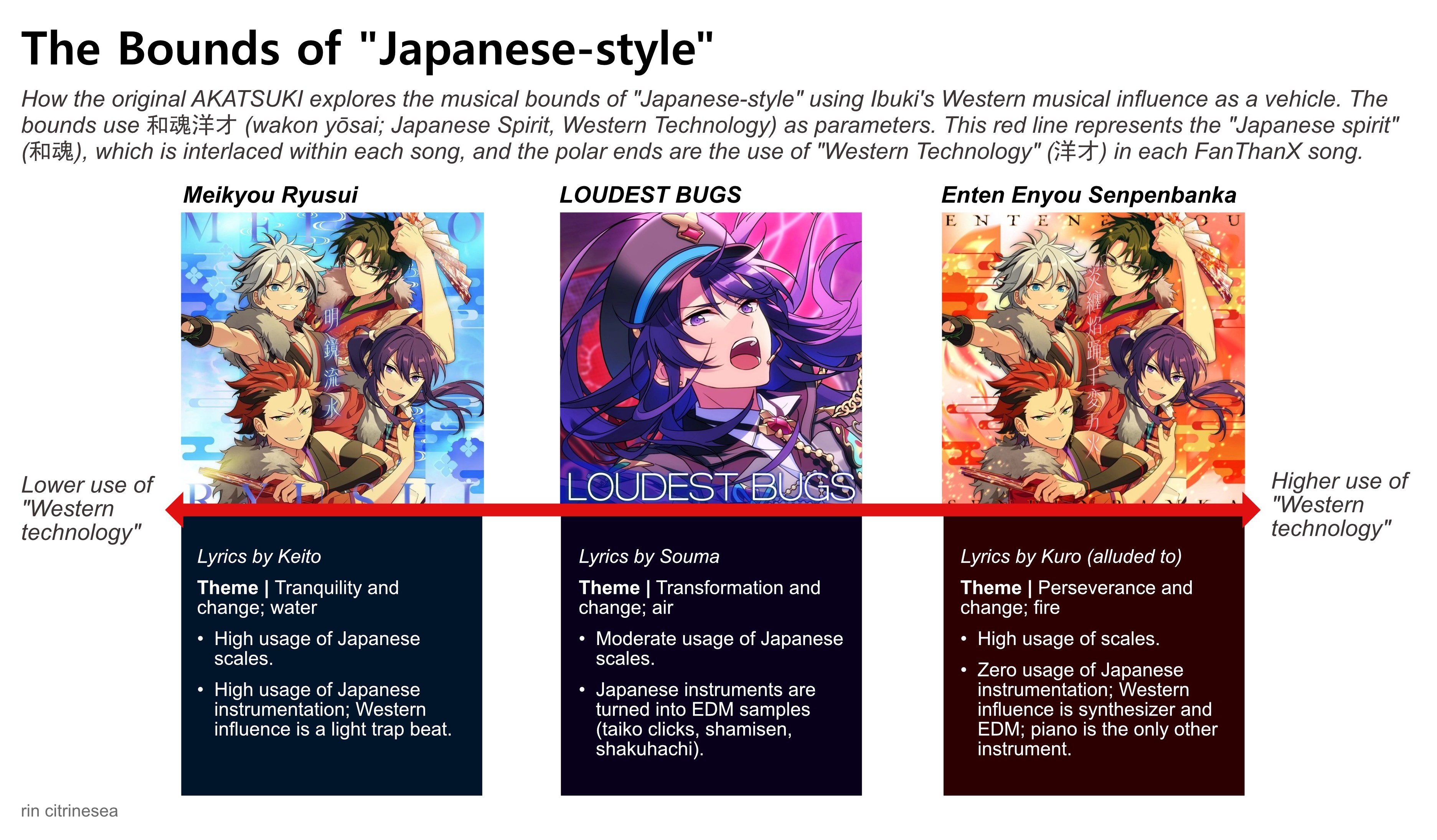
The graph below uses 和魂洋才 (wakon yōsai) as parameters to represent the use of western influence in each song. The red line represents the "Japanese spirit" (和魂), which is interlaced within each FanThanX song, and the polar ends are the use of "Western Technology" (洋才) in each FanThanX song. Given the production note says that Meikyou Ryusui and Enten Enyou Senpenbanka represent "the range", they are the two bounds.
Meikyou Ryusui
⦿ Keito's song lies on the left side of the "Western Technology" end. Meikyou Ryusui uses a high amount of Japanese instrumentation and pentatonic scales. The Western influence is light, reflected in the subtle trap beat throughout the song. Keito's lyrics are ornate and poetic and utilize Japanese yojijukugo (or 4-kanji idioms). Of the three songs, this is the most "typical AKATSUKI-like song".
⦿ Similar songs to Meikyou Ryusui would be Usubeniiro no Yakusoku (Pale Red Vow) or Matsuriyo Emaki (Festival Scroll Night). Pale Red Vow uses the "big three" of traditional Japanese instruments (shamisen, shakuhachi and koto), but also heavily relies on non-traditional instruments like electric guitar and string orchestra. Festival Scroll Night is also similarly "traditional", but actually uses synth and synth keys in place of where a koto would be used.
LOUDEST BUGS
⦿ Souma's song has a balanced use of "Western Technology". The song begins with blending Western and Japanese influence, with Japanese instruments used to create EDM samples (e.g., taiko stick clicks, shamisen, shakuhachi). It also incorporates a moderate use of pentatonic scales. Souma uses complex phrasing in his lyrics, but also incorporates English suggestions from Ibuki.
⦿ A similar song to LOUDEST BUGS would be Tenshou KAGETSU, which shares a similar ratio of traditional Japanese instrumentation to non-traditional, as well as sampled Japanese instruments.
Enten Enyou Senpenbanka
⦿ Kuro's song lies on the right side of the "Western Technology" end. The song ultimately relies on the use of pentatonic scales for its Japanese-style influence, and expressly avoids using traditional Japanese instrumentation (only consisting of synthesizer and piano).
⦿ Kuro's lyrics are passionate and straightforward, characteristic of the assertiveness Keito desires for AKATSUKI. The hungry fire that "never stops seeking more heat" like a fire that eats up everything in its path, is the hunger Keito wants AKATSUKI to obtain.
Together, the three FanThanx songs feel like a Ship of Theseus experiment: to what extent does the existence or absence of instrumentation and pentatonic scales make something Japanese-style? As you take away components like "traditional Japanese instruments" or the use of pentatonic scales characteristic of "Japanese-style music," at what point does it stop being "Japanese-style"?
Translation Notes and References
- ↑ If you listen closely to lines like this, each singer has a higher version of the line they harmonize with, as if they're singing with their reflection.
- ↑ 暁 (akatsuki, dawn or daybreak) is a homonym with AKATSUKI.
- ↑ 嗚呼 (aa, a sigh of breath at the beauty of nature) is rarely written with kanji. Here, it's probably used to make it clear that the lyric is a relaxed sigh of breath.
- ↑ You can hear the piano do cascading arpeggios, which gives the song a water-like quality.
- ↑ 和 (wa) refers to a foundational cultural value in Japan that emphasizes social harmony through maintaining peaceful relationships within a group. 和 encourages compromise, consensus, and the avoidance of open conflict. Generally, it can refer to "Japanese-ness", and is used in words like 和風 (wafu, Japanese style). Read more about the problematic implications the use of 和 (wa) has for Ibuki and AKATSUKI here.
- ↑ I translated this as "O Soul" in order to match the "O Water's Mirror" in Meikyou Ryusui. I also translated out the name of the song mostly literally in this line, because of the powerful whimsy.
- ↑ 諸行無常 (shogyou mujou; all things are impermanent), a Buddhist fundamental that says that everything in the universe is in constant change and motion, and clinging to the things as if they're permanent is the root of suffering.
- ↑ Zohar, A., & Miller, A. J. (Eds.). (2021). The visual culture of Meiji Japan: negotiating the transition to modernity. Routledge.
- ↑ Hamon is the visible effect on the outline of a blade that is smithed. The hamon is created during differential heat treatmenet, where red-hot metal is plunged in water and supercooled.